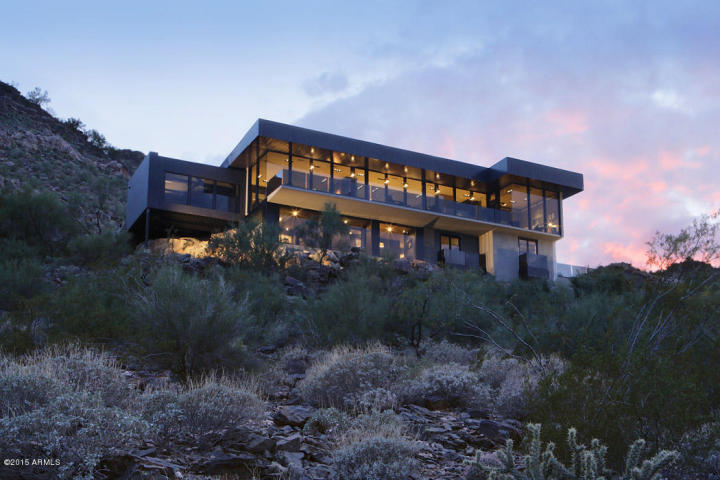
Realtor.com just dropped a data‑packed piece titled “Phoenix vs. Denver: How the Valley of the Sun Dethroned the Mile High City as the West’s Luxury Heavyweight” — and it confirms what anyone paying attention to Arizona real estate already knows:
Phoenix isn’t chasing Denver anymore. Phoenix has passed Denver — and Paradise Valley is the reason why.
A decade ago, Denver led the Mountain West in luxury pricing. Today, Phoenix has taken the crown, and Paradise Valley is the ultra‑luxury anchor pulling the entire region upward.
With a median listing price of $4.99 million — and yeah, no, this isn’t some Realtor psychological pricing trick, it really is $4.99M — Paradise Valley isn’t just outperforming Denver, it’s leaving it in the dust. Denver’s most expensive ZIP code (Franktown, 80116) tops out at $1.75M, barely a third of PV’s median. That gap isn’t just big — it’s the single largest divergence in the entire Western luxury market, and it cements Paradise Valley as the undisputed heavyweight of the Mountain West.
And it raises the question every Arizona local is asking:
Who the fuge is buying these homes?
Let’s break it down.
1. Paradise Valley Is Now the Benchmark for Western Luxury
The Realtor.com analysis comparing Phoenix and Denver’s luxury markets makes one thing clear: Paradise Valley is in a league of its own. Denver’s most expensive ZIP code (Franktown, 80116) has a median listing price of $1.75 million. Paradise Valley? $4.99 million — nearly three times higher.
It’s the single biggest divergence between the two metros, and a reminder that we’re not the Wild Wild West anymore. Phoenix has evolved into a modern luxury powerhouse, and Paradise Valley is the crown jewel pushing the Valley far ahead.
2. Limited Land + Tear‑Down Culture = Permanent Scarcity
Paradise Valley is only 15 square miles. Almost every buildable lot is already spoken for, and the new norm is:
Buy a $2M home → tear it down → build a $10M estate.
This cycle permanently pushes the median upward. There is no “starter home” in PV. There is no “entry level.” There is only luxury and ultra‑luxury, and the land constraints guarantee it stays that way.
3. Phoenix’s Luxury Market Surged — and PV Rode the Wave
The Realtor.com report shows Phoenix’s luxury threshold (top 10%) is now $1.5M, higher than Denver’s $1.35M.
But the real separation happens at the top:
- Phoenix top 5%: $2.66M
- Phoenix top 1%: $6.72M
- Paradise Valley median: $4.99M
PV sits squarely inside the top 1% bracket — and often above it.
Even during the correction:
- Denver luxury fell 27%
- Phoenix luxury fell 15%
- PV barely flinched
Why? Because wealth buyers don’t react to interest rates. They react to lifestyle, privacy, and tax strategy.
4. Wealth Migration Is Fueling the Fire
Phoenix and Denver are each other’s top migration corridors — but Phoenix has the advantage: warmer climate, no state income tax, and deeper luxury inventory.
Add in buyers from California, Washington, Illinois, and New York, and you get a flood of high‑net‑worth individuals who:
- buy in cash
- don’t care about mortgage rates
- want land, views, and privacy
- see PV as a “value” compared to LA or Manhattan
A $10M estate in PV would be $25M+ in Beverly Hills. To them, this is discount luxury.
5. The Affordability Gap Is Absurd — and Growing
Median household income in Arizona: ~$74,000 Median home in Paradise Valley: $4,990,000
That’s a 67× income‑to‑home‑price ratio.
For locals, PV might as well be Monaco. It’s no longer part of the Arizona affordability conversation — it’s a global luxury asset class.
6. What This Means for the Rest of Phoenix
Paradise Valley’s surge has spillover effects across the metro:
- Arcadia prices climb
- Scottsdale luxury expands north
- Biltmore and North Central see more tear‑downs
- Local buyers get pushed farther out (Queen Creek, Goodyear, Buckeye)
PV is the tip of the spear — and the rest of the metro follows.
Final Takeaway
Paradise Valley’s $5M median isn’t a bubble. It’s the result of:
- limited land
- wealth migration
- trophy‑home construction
- Phoenix’s rising luxury profile
- and a buyer pool that doesn’t blink at eight‑figure price tags
Paradise Valley is no longer “Arizona luxury.” It’s international luxury that happens to be in Arizona.












 AriZona Real Estate insider
Leave a comment