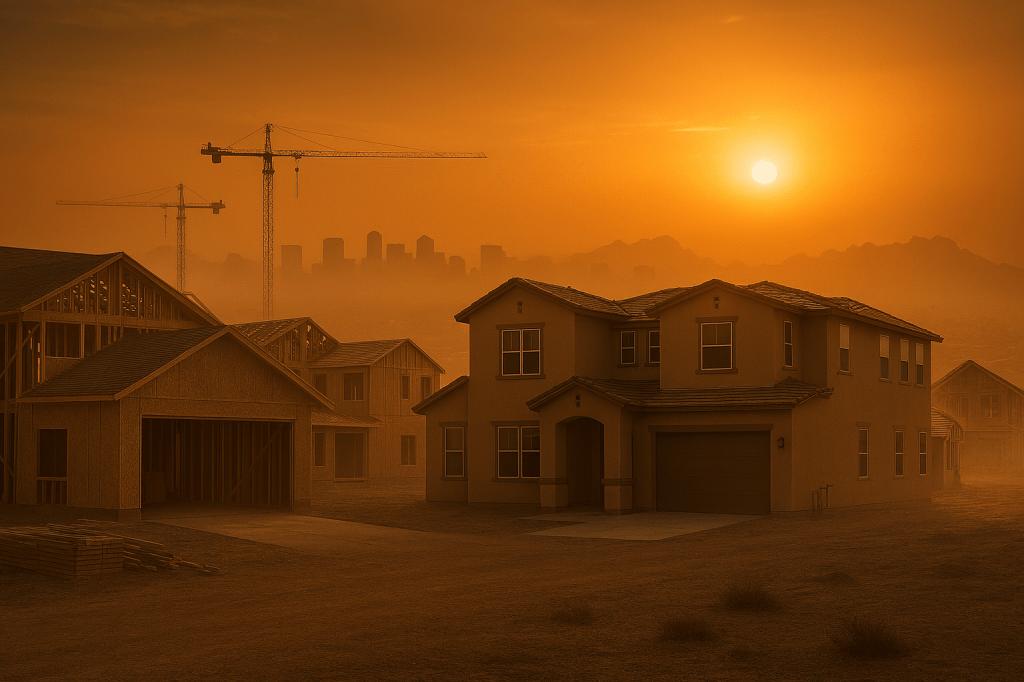
Drive anywhere in Phoenix right now — Buckeye, Queen Creek, North Peoria, Tempe — and it looks like we’re in a construction renaissance. Cranes everywhere, new subdivisions eating up the desert, luxury apartments rising like weeds.
Pero aquí entre nos… this boom isn’t built for the people who actually live here. It’s built for the people who can afford to outbid them.
And that’s why the whole thing feels like a mirage — una ilusión shimmering over the Valley floor.
Phoenix Is Building More Than Almost Any Metro… But Not for Us
The article lays it out clearly: Phoenix is one of six metros where new construction is booming. In fact, 12.7% to 22.4% of all housing stock in these metros was built from 2010 to 2023, compared to 11.35% nationwide.
That should be great news for affordability, right?
Ni madre compa.
Because as the article puts it, “Coastal and Sun Belt cities are ramping up construction on housing — but not the kind of housing that most people can afford.”
Phoenix is building a ton — just not the stuff regular Phoenicians can actually buy.
The Disappearing Starter Home
One of the most striking stats in the article is this:
“33% of homes built in the 1980s contain four or more bedrooms… for housing stock since 2010, almost 59% had that many.”
Translation: We’re not building starter homes anymore. We’re building big, expensive, high‑margin homes.
Developers aren’t dumb — they follow the money. But the result is brutal for locals trying to get their first foothold in the market.
As the Georgetown study quoted in the article says:
“The private sector isn’t meeting the needs for lower-income households, and probably not the middle class, either.”
That line hits hard because it’s exactly what we see on the ground in Phoenix.
Luxury Rentals Everywhere — But Who Are They For?
The article also points out that new rentals are overwhelmingly concentrated in large multifamily buildings with small units — the luxury stuff we see all over Downtown Phoenix, Tempe, and Scottsdale.
And here’s the kicker:
“Moderate-, middle-, and high-income renters occupy an overwhelming 55% of the newest housing stock.” Only 45% are low or extremely low income.
Compare that to older buildings, where 63% of renters were low or very low income.
So even the rental market is shifting upward — pricing out the people who actually keep this city running.
The Missing Middle Is… Missing
The article confirms what we’ve all been saying:
“Just under 4% of newly built owner-occupied units were duplexes, triplexes, and other denser housing types.”
Four percent. Cuatro. That’s nothing.
No duplexes. No triplexes. No townhomes. No courtyard homes.
Just luxury apartments and big suburban homes.
This is exactly why Phoenix feels like it has two markets:
- Luxury new builds, and
- Aging older stock
Nothing in between.
So Who Does This Boom Really Serve?
Let’s be real:
It serves high‑income households moving in.
They can afford the new builds and the luxury rentals.
It serves developers chasing higher margins.
They’re not charities — they build what pays.
It serves institutional investors.
The article even notes that Phoenix has an “outsized share of institutional investors” compared to other metros.
But it does not serve the average local buyer or renter.
At least not yet.
What Needs to Change?
The article quotes Georgetown’s recommendation clearly:
“A combination of zoning reform, financial tools, and inclusionary practices… especially ‘missing middle’ housing more attainable for middle- and low-income buyers.”
Phoenix doesn’t have a construction problem. It has a priorities problem.
If we want to keep the Valley livable for the people who actually built this place, we need:
- Smaller homes
- More diverse housing types
- Zoning reform
- Incentives for affordability
- Less “luxury everything”
Final Take
Phoenix is building like crazy — but the boom is a mirage if locals can’t afford the homes being built.
The construction is real. The affordability? Not so much.
And until the Valley starts building for the middle of the market — not just the top — the people who make Phoenix what it is will keep getting pushed out.










 AriZona Real Estate insider!
Leave a comment